
AI Search Optimization for Graduate Programs: What to Measure in 2026
Graduate education search behavior is changing quickly. Prospective students still use Google, university websites, and program pages, but they are also asking AI tools to compare programs, explain admissions requirements, summarize tuition differences, and decide which schools belong on a shortlist.
That shift matters because the old measurement model assumes the important interaction starts when someone clicks.
In 2026, that assumption is too narrow.
In UPCEA/Search Influence research cited in Search Influence’s 2026 graduate education AI search analysis, half of professional and continuing education prospects used AI-powered tools at least weekly for general information search. For program research specifically, 36% said they were extremely or very likely to use AI chatbots, and 35% said the same for AI search engines.
A prospective graduate student may ask ChatGPT, Gemini, Perplexity, or Google’s AI results for advice before ever reaching a university website. They may see a program mentioned, compared, summarized, or left out entirely. By the time that person appears in analytics, the decision journey is already underway.
That is why graduate programs need to think beyond traditional SEO and start building for AI search visibility.
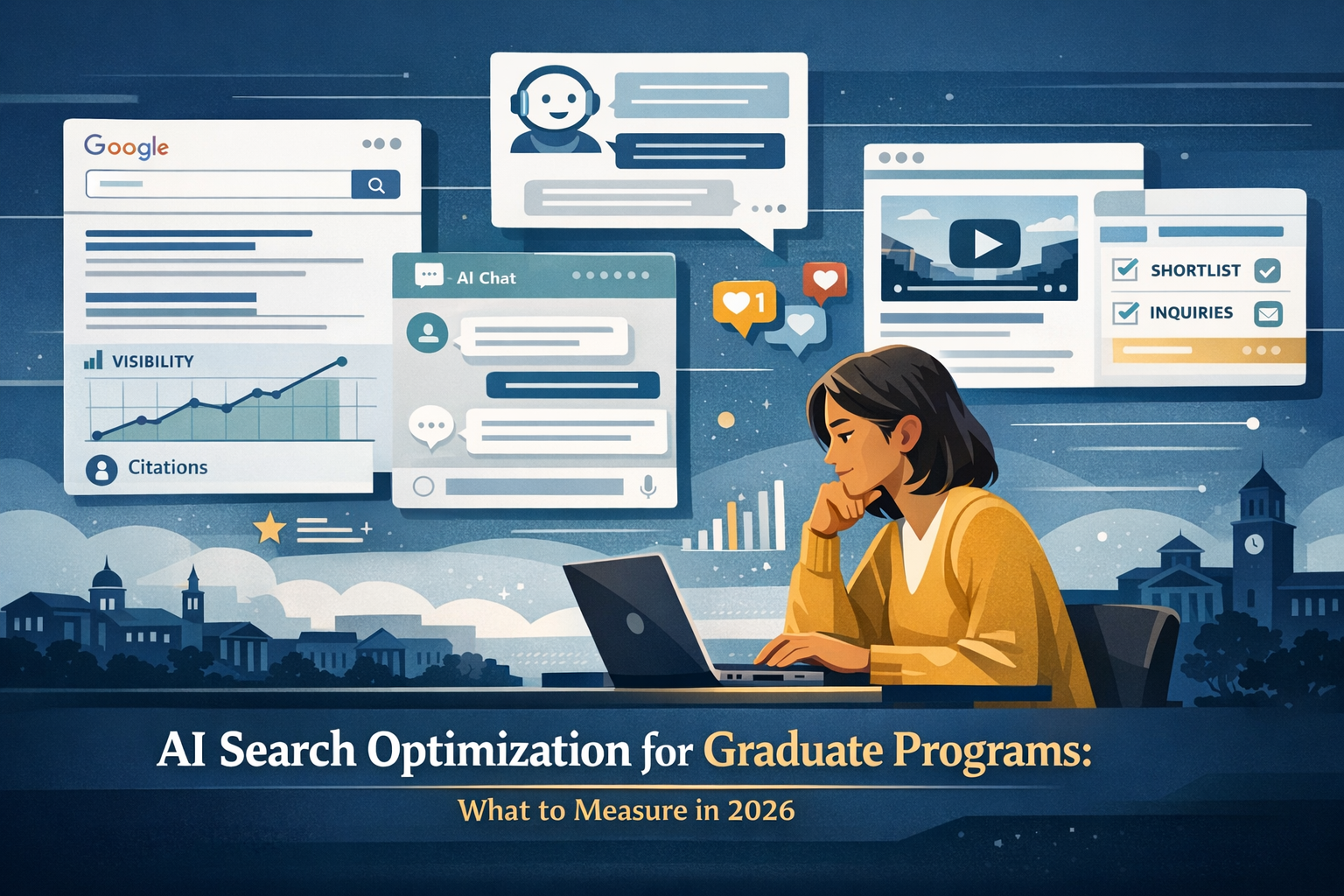
Graduate Prospects Are Searching Across More Platforms
Search is no longer confined to a blue-link results page. Graduate and professional education prospects use a mix of search engines, university websites, AI chatbots, YouTube, social platforms, and peer-driven communities as part of the same research process.
The mix matters. The same UPCEA/Search Influence study found that 84% of prospects were extremely or very likely to use traditional search engines for program research, while 63% said university websites, 36% said AI chatbots, 35% said AI search engines, and 34% said social media. In other words, AI is not replacing the classic graduate search journey. It is adding another layer on top of it.
There is also a behavior gap between how marketers organize channels and how prospects actually search. In the study, 61% of prospects said they use YouTube like a search engine, and 50% said they use AI tools the same way. That makes program visibility a cross-platform problem, not just an SEO problem.
That does not mean traditional SEO is dead. It means traditional SEO has become the foundation, not the finish line.
For graduate programs, the content that used to live only on program pages now needs to be clear enough for AI systems to understand, summarize, and cite. Admissions requirements, deadlines, tuition, delivery format, career outcomes, faculty expertise, accreditation, and program differentiators all need to be easy to find and easy to interpret.
If that information is vague, buried, or inconsistent across pages, AI systems may fill the gap with a competitor’s content instead. This is where strong higher education SEO and AI-ready content structure start to overlap.
Zero-Click Search Changes the Enrollment Funnel
One of the biggest implications for graduate education marketers is the rise of zero-click search. More questions are being answered directly in search results or AI-generated summaries, which means prospects may get useful information without visiting a school’s website.
That creates a reporting problem.
Search Influence’s 2026 analysis points to a sharp measurement gap: roughly 69% of Google searches ended without a click as of May 2025, up from 56% a year earlier. When AI Overviews appear, reported click-through declines for top-ranking websites can reach 70% to 90%. Even if those numbers vary by query type, the direction is clear: more of the research journey is happening before the visit.
Traffic may flatten even while awareness is growing. Click-through rates may decline even while a program is being discovered more often. Analytics may show fewer sessions, but not the number of times a school was mentioned or cited in an AI answer.
The opportunity is that citations can also function as trust signals. In the UPCEA/Search Influence research, 51% of prospects said they click AI Overview sources most of the time or always, and 56% said they are more likely to trust brands or websites cited in AI Overviews.
For enrollment teams, traffic is still useful, but it can no longer be the only measure of search performance. Graduate programs should also track:
- Whether the program appears in AI-generated answers for priority queries
- Whether the institution is cited as a source
- Whether program details are represented accurately
- Which competitors appear in the same AI responses
- Whether visibility connects to branded search, inquiries, applications, and enrollment
The key question is not just “Did they click?”
It is “Were we visible when the prospect was forming the shortlist?”
That is also why GEO metrics and engagement-quality measures matter more as AI search becomes part of the enrollment journey.
What Graduate Programs Should Do Now
AI search optimization starts with clarity. Graduate program pages should answer the questions prospects actually ask, in plain language and structured formats.
That includes:
- Program cost and financial aid information
- Admissions requirements and deadlines
- Online, hybrid, and in-person format details
- Career outcomes and employer relevance
- Faculty expertise and research strengths
- Student support services
- Comparisons between related programs
- FAQs written around real prospect questions
This content should not be written only for rankings. It should be written so humans and AI systems can both understand what the program offers and why it matters.
Structured headings, concise answers, comparison tables, and consistent naming all help. So does schema markup for universities, especially when program information, organization details, FAQs, and breadcrumbs need to be interpreted reliably.
If your next project is tactical, start with your highest-priority program pages. Make sure they answer the questions prospects and AI systems are most likely to ask. This guide on how to optimize university program pages for AI-driven search is a good next step.
FAQ: AI Search Optimization for Graduate Programs
What is AI search optimization for graduate programs?
AI search optimization is the process of making graduate program information easy for AI systems, search engines, and prospective students to understand, summarize, and cite. It builds on traditional SEO but adds more emphasis on clarity, structured answers, entity consistency, and visibility inside AI-generated responses.
Does traffic still matter for graduate enrollment marketing?
Yes. Traffic still matters because website visits can signal interest and drive inquiries or applications. But traffic no longer captures the full journey. A prospect may evaluate a program through AI answers or zero-click search before visiting the website, so enrollment teams need visibility and citation metrics alongside sessions.
What content should graduate programs prioritize for AI search?
Graduate programs should prioritize content that answers real decision-stage questions: cost, admissions requirements, deadlines, program format, career outcomes, accreditation, faculty expertise, and comparisons between related programs. Clear FAQ sections and structured program pages are especially useful.
The Opportunity for Higher Education SEO
The schools that move first will have an advantage. Many graduate programs are still measuring search primarily through rankings, clicks, and sessions. Those metrics remain important, but they do not capture the whole decision journey anymore.
AI search optimization gives universities a way to influence discovery before the visit. It helps programs appear where prospects are asking questions, comparing options, and deciding who deserves more attention.
That is the next layer of higher education SEO.
For a deeper look at the research behind this shift, including AI adoption, zero-click search, and graduate enrollment implications, read the full Search Influence article: AI Search Optimization for Graduate Education Marketing in 2026.